T
Loading…
Loading…
Last Updated: September 2026
If you shop for shoes in Nigeria, a clear shoe size conversion chart saves time, reduces returns, and helps you compare UK, US, and EU labels with confidence. In Nigeria, many sellers and buyers still use UK sizing as the reference point, while imported pairs often carry US or EU labels, so the safest approach is to compare the shoe’s printed size with foot length in centimetres.
One reason shoe shopping feels inconsistent is that shoe labels do not always mean the same thing across brands. A UK 6, US 8, and EU 39 can refer to the same general fit in many charts, but the exact match can shift slightly by brand, gender line, and shoe shape.
That is why a conversion chart works best as a guide, not as a guarantee. Foot length, width, toe shape, and whether the shoe is narrow or roomy all affect comfort, especially in secondhand shopping where the original box may be missing.
The table below gives a practical reference for buyers in Nigeria using commonly published charts from Nigerian retailers and size guides.
| Foot length | UK size | US women | US men | EU size | Nigerian common label |
|---|---|---|---|---|---|
| 22.8 cm | 3 | 5 | 4 | 35.5 | 35–36 |
| 23.1 cm | 3.5 | 5.5 | 4.5 | 36 | 36 |
| 23.5 cm | 4 | 6 | 5 | 37 | 37 |
| 23.8 cm | 4.5 | 6.5 | 5.5 | 37.5 | 37–38 |
| 24.1 cm | 5 | 7 |
Have something to give away or sell?
Post your first listing — it only takes a couple of minutes.
| 6 |
| 38 |
| 38 |
| 24.6 cm | 6 | 8 | 7 | 39 | 39 |
| 25.4 cm | 7 | 9 | 8 | 40 | 40 |
| 26.2 cm | 8 | 10 | 9 | 41 | 41 |
| 27.0 cm | 9 | 11 | 10 | 42 | 42 |
| 27.8 cm | 10 | 12 | 11 | 43 | 43 |
| 28.6 cm | 11 | 13 | 12 | 44 | 44 |
| 29.0 cm | 11.5 to 12 | 13.5 to 14 | 12.5 to 13 | 45 | 45 |
A useful pattern for many Nigerian shoppers is that women’s sizes often cluster around UK 4 to 7, while men’s sizes often cluster around UK 7 to 10, though foot shape and brand differences still matter.
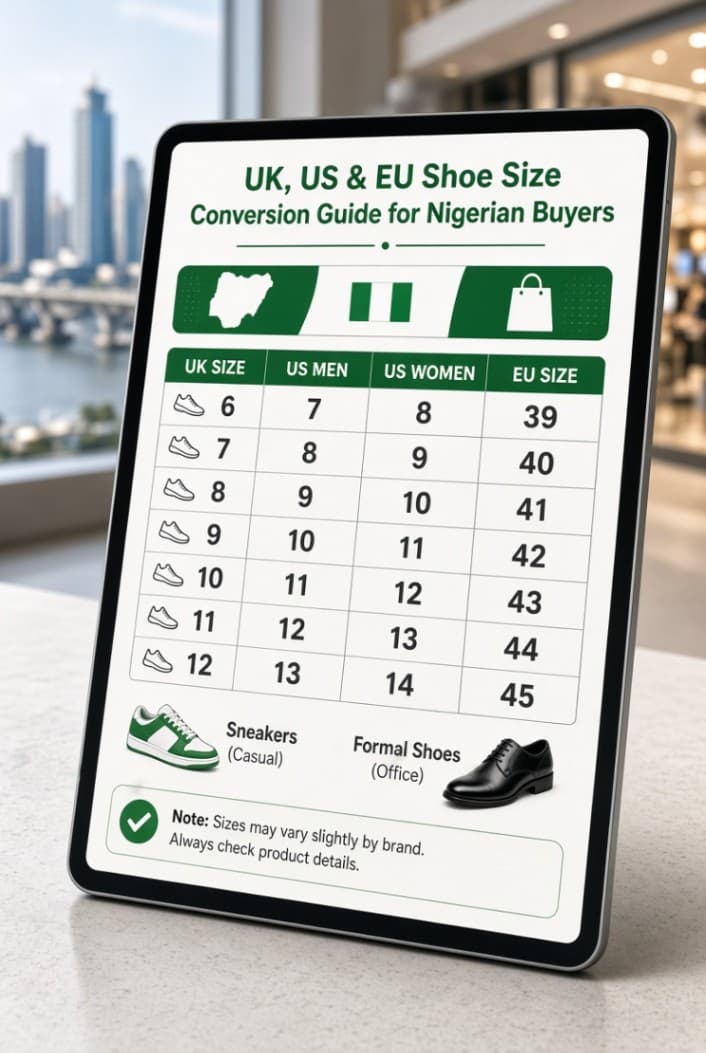
For many shoppers, the most useful conversion is UK to US and UK to EU because imported shoes on resale pages usually carry one of those systems. A common reference pattern is UK 5 = US 7 = EU 38, UK 6 = US 8 = EU 39, UK 7 = US 9 = EU 40, and UK 8 = US 10 = EU 41.
Here is a cleaner comparison for everyday buying:
| UK | US women | US men | EU |
|---|---|---|---|
| 3 | 5 | 4 | 35.5 |
| 4 | 6 | 5 | 37 |
| 5 | 7 | 6 | 38 |
| 6 | 8 | 7 | 39 |
| 7 | 9 | 8 | 40 |
| 8 | 10 | 9 | 41 |
| 9 | 11 | 10 | 42 |
| 10 | 12 | 11 | 43 |
| 11 | 13 | 12 | 44 |
If you are comparing thrift listings, the UK number is often the quickest starting point because many sellers in Nigeria describe imported shoes that way. When the listing also gives foot length in cm, that is even better because it is easier to verify against your own measurement.
To measure accurately, place a sheet of paper on a hard floor, stand on it with your heel against a wall, and mark the longest toe. Measure the distance in centimetres and compare it with the chart above; many guides in Nigeria and abroad use this method because it reduces guesswork.
This is especially helpful for secondhand shoes because thrift shoes may have softened insoles, stretched uppers, or worn lining that changes the fit slightly. Foot-length measurement gives you a more reliable reference than relying only on a label.
A simple example makes conversion easier to use in real life. If a seller posts a UK 6 pair on a WhatsApp marketplace and you usually wear EU 39, that listing is likely in your range because UK 6 commonly aligns with EU 39 and US 8 in many Nigerian size guides.
Another example: if you usually wear a 25.4 cm foot length, the chart points you to UK 7, US women 9, US men 8, and EU 40 in many published references. For loafers, sneakers, and boots, that same foot length may still need a small comfort check because some designs fit tighter at the toe box.
Shoe size accuracy matters even more in Nigeria’s resale market because the price gap between an almost-right pair and a poor fit can be significant. On peer-to-peer and thrift listings, casual sandals, flats, and lightly used sneakers often appear in ranges that vary by condition, brand, and city, so the buyer loses less when the fit is checked before payment.
| Shoe type | Common secondhand price range in Nigeria |
|---|---|
| Slippers / slides | ₦2,000 to ₦8,000 |
| Flat shoes / loafers | ₦3,000 to ₦15,000 |
| Sneakers | ₦5,000 to ₦30,000 |
| Heels / dress shoes | ₦4,000 to ₦20,000 |
| Boots | ₦8,000 to ₦35,000 |
These are practical market ranges for everyday thrift browsing, not fixed prices. Brand, condition, rarity, and whether the seller includes original packaging can move the amount up or down quickly.
When shopping online in Nigeria, the Federal Competition and Consumer Protection Commission says businesses should provide clear product information and full disclosure of prices, and consumers have rights to information in plain language. The FCCPC also says consumers should first raise the issue with the seller, then escalate the complaint if it is not resolved, and it provides a complaint process for consumers who need redress.
For shoe buying, that means the listing should clearly show size, condition, price, and any known defects. If the description says “UK 7” but the item arrives very different from the advertised size or condition, the issue becomes a mismatch between the stated description and the delivered item, which consumer-protection guidance treats as a red-flag transaction.
These steps are useful in WhatsApp-first trading because there is no app-based checkout to rely on. Good records make it easier to compare the listing with what was agreed in the chat.
Children’s sizes are even more sensitive to foot length because a small conversion error can make the shoe uncomfortable very quickly. For kids, sellers should ideally list age only as a rough guide and add centimetres, since age alone does not give a reliable fit.
For unisex shoes, UK size and foot length are usually more helpful than gendered labels. If a sneaker is marked unisex, compare the cm measurement first, then use UK, EU, or US only as a secondary reference.
If you are posting or comparing shoes in a secondhand marketplace, a clear listing reduces back-and-forth and helps genuine buyers decide faster. A good listing includes the size system, foot length in cm, condition, and whether the shoe fits narrow or roomy.
That format is useful because it mirrors how buyers search and how size guides are usually published by Nigerian retailers and conversion tools.
A common mistake is assuming every EU 40 fits the same way. In practice, two shoes with the same label can fit differently because of brand grading, toe shape, and construction.
Another mistake is buying only by visual judgement in photos. Shoe photos can hide wear, compress the toe area, or make a narrow shoe look broader than it is, so size and foot length should be confirmed in writing before the deal is finalised.
On Threddo.com.ng, a listing that includes UK, US, EU, and centimetre measurements is easier for buyers to trust, especially when the exchange happens directly between users on WhatsApp. That kind of detail supports safer secondhand trading and fewer sizing mistakes.
The most reliable way to handle shoe size conversion in Nigeria is to use foot length in centimetres first, then confirm the matching UK, US, and EU sizes from a chart. For thrift, resale, and peer-to-peer shopping, that approach is more consistent than guessing from labels alone, especially when product descriptions are short or the shoe comes from a different market standard.
This article is for educational purposes only and does not constitute professional advice. Always follow safe trading practices and use your own judgement.