T
Loading…
Loading…
Last Updated: September 2026
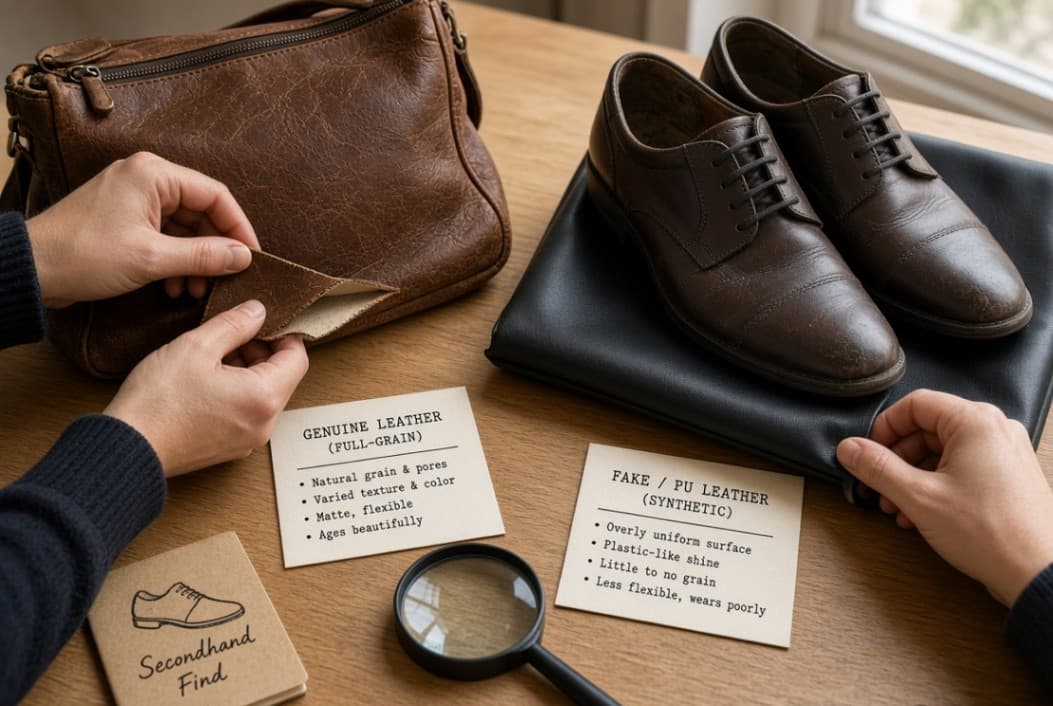
Buying a secondhand bag or pair of shoes can be a smart way to stretch your budget, but leather labels are often used loosely, and not every “leather” item is genuine leather. In practice, the clearest signs come from a mix of look, feel, smell, edge construction, and seller transparency, rather than one single test.
Genuine leather usually shows small irregularities because it comes from animal hide, so the grain is rarely perfectly repetitive across the entire surface. It often feels soft, flexible, and slightly warm in the hand, while fake leather tends to feel more uniform, cooler, and sometimes overly smooth or plasticky.
In shoes and bags, real leather often develops natural creases and bends more easily around stress points such as toe boxes, strap edges, and handle folds. Fake leather may keep a stiff shape longer, or it may show a surface pattern that repeats too neatly from one section to another.
When I inspect a secondhand item, I start with the parts that give the most clues in the shortest time. A seller may use the word “leather,” but the item still needs to pass a few basic checks before that description carries weight.
Look closely at the surface under good light. Real leather usually has uneven pores, tiny scars, and a grain pattern that changes naturally from one area to another, while fake leather often has a stamped or printed pattern that repeats in a more regular way.
Real leather usually has an earthy, slightly warm scent from the hide and tanning process, while fake leather often smells like plastic, glue, chemicals, or nothing much at all. This works well on bags, shoe uppers, straps, and inner flaps, especially when the item has been sealed in a bag and the smell is still obvious after opening.
Check a raw edge, folded seam, or hidden underside. Genuine leather often shows a fibrous, layered structure at the edge, while faux leather commonly has a fabric backing or a smooth synthetic layer underneath. On secondhand bags, the underside of a strap, the inside of a handle, or the lip around a pocket opening can be especially useful.
Run your fingers across different parts of the item. Real leather usually feels supple and varied, while fake leather may feel too uniform or slightly rubbery, and it often does not warm up as quickly in your hand. If the surface stays rigid even after gentle handling, that is a useful warning sign, though not proof by itself.
Have something to give away or sell?
Post your first listing — it only takes a couple of minutes.
A tiny drop of water on a hidden spot can reveal a lot. Genuine leather often absorbs moisture gradually, while many synthetic materials make water bead up on the surface or sit there for longer. This test should be done only on an inconspicuous area, because some finished leathers can mark if left wet for too long.
| Check | Genuine leather | Fake leather |
|---|---|---|
| Grain | Irregular, natural, non-repeating | More uniform or stamped |
| Smell | Earthy, leathery, slightly warm | Plastic, glue-like, chemical |
| Edges | Fibrous, layered, natural underside | Fabric backing, smooth synthetic layer |
| Touch | Supple, warm, varies across the surface | Cooler, more rigid, sometimes rubbery |
| Water drop | Absorbs gradually in many cases | Beads on top or stays on the surface |
A flame test is sometimes mentioned online, but it damages the item and is not a practical everyday check for a secondhand market purchase. A safer approach is to rely on multiple non-destructive signs together, because one feature alone can be misleading, especially with coated leather, corrected grain leather, or higher-grade synthetic materials.
Avoid assuming that every item with a designer-style look is genuine leather. Some synthetic shoes and bags are made to imitate grain, scent, and texture closely, so the safest habit is to inspect the whole item, not just the logo or the seller’s description.
In Nigeria, consumer protection rules under the Federal Competition and Consumer Protection Act support the right to accurate product information, clear description, and protection from misleading claims. The FCCPC also provides a channel for consumer complaints where goods are misdescribed or sold deceptively.
For secondhand trading, that means listing clarity matters. If a seller says an item is genuine leather, the useful practice is to show close-up photos of the grain, edges, soles, linings, and any wear spots, because those details help the buyer verify the claim before meeting or paying. On the buyer side, keeping screenshots of the listing, chat history, and payment record gives you a clearer trail if the item arrives materially different from what was described.
Use this as a fast pre-payment review for shoes and bags:
This checklist is especially useful in busy markets, where you may have only a few minutes to inspect an item before deciding. It also works well for online secondhand shopping, where photos can hide edge construction and texture differences that are easier to catch in person.
Price alone does not prove authenticity, but it can help you ask better questions. In Nigeria’s secondhand market, genuine leather shoes and bags often sit in a wider price band depending on brand, condition, and craftsmanship, while lower-priced pieces may be synthetic, heavily worn, or simply unbranded. A low price is not proof of fake leather, but it is a good reason to inspect the item more closely and ask for clearer pictures of the interior and edges.
Here is a simple way to think about it:
| Item type | Lower-risk signs | Extra questions to ask |
|---|---|---|
| Leather shoes | Natural crease lines, real leather smell, stitched upper | Is the upper full-grain, top-grain, or coated? |
| Leather bags | Fibrous edges, natural grain variation, soft handles | Is the lining leather, fabric, or synthetic? |
| Small leather goods | Slight scent, flexible folds, visible pores | Are all panels the same material? |
One common mistake is confusing “genuine leather” with “real leather” and assuming both always mean high-grade material. Another is trusting a smooth finish alone, because many real leathers are coated, corrected, or heavily finished to look more uniform. A third mistake is ignoring the underside and edges, even though those areas often reveal the most useful clues.
A practical habit is to compare two items side by side when possible. Once you see one clearly fake bag and one clearly genuine leather bag, the differences in smell, softness, and edge structure become much easier to recognize in future purchases.
Imagine you are checking a used tote in Ibadan or Lagos and the seller says it is leather. The front panel has a perfectly repeated pebble pattern, the smell is strongly chemical, and the inside edge reveals a fabric backing, so the item is much more likely to be synthetic than genuine leather. If the same bag also shows natural creasing, an earthy smell, and a fibrous cut edge, the signs move in the opposite direction.
That kind of step-by-step check is more reliable than asking only, “Is it leather?” because the answer depends on what part of the item you inspect and how closely the seller’s description matches the actual material.
When listing secondhand shoes or bags on Threddo, clear close-up photos of the grain, edges, lining, and soles help buyers verify what they are seeing before they message you, which supports safer and smoother trading. You can also point buyers to the platform’s safety guidance and keep the listing description precise so the material is not overstated or misunderstood.
The most reliable way to tell genuine leather from fake on secondhand shoes and bags is to combine grain, smell, edge, feel, and a small hidden water test rather than relying on a logo or one quick glance. In Nigeria, accurate descriptions and clear evidence are also important because consumer protection rules support truthful product information and redress for misleading sales.
This article is for educational purposes only and does not constitute professional advice. Always follow safe trading practices and use your own judgement.