T
Loading…
Loading…
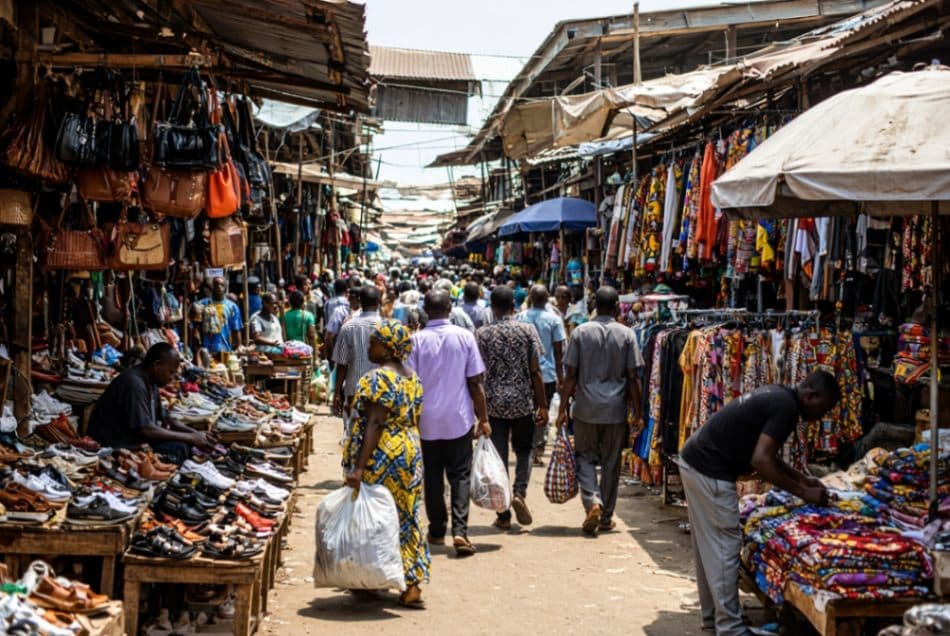
Ariaria International Market in Aba, Abia State, is one of Nigeria’s most important trading and manufacturing centres for shoes, leather goods, clothing, bags, fabrics, accessories, electronics, and household products. It is particularly relevant to fashion traders because many products are made, repaired, customised, or sold in bulk within specialised market clusters.
The market was established in 1976 after traders moved from Ekeoha Market following a fire outbreak. Its reputation for locally made shoes, bags, garments, and leather products has contributed to Aba’s nickname, the “China of Africa.” An Appraisal of the Contributions of Ariria Market in Aba, Abia
Whether you are buying one item, restocking a boutique, sourcing for online sales, or looking for secondhand clothing, Ariaria rewards preparation. Prices, quality, minimum quantities, and availability can vary from one stall or production cluster to another.
Ariaria International Market is located in Aba, Abia State, in southeastern Nigeria. The wider market area is associated with Aba North, Aba South, and Osisioma, although the exact trading cluster depends on the product being purchased. Ariaria International Market
Aba is connected by road to cities including Umuahia, Port Harcourt, Owerri, Onitsha, and Enugu. Visitors travelling from outside Abia commonly use buses, taxis, or private vehicles and then take local transport to the relevant market entrance or line.
Because Ariaria is a large, decentralised market rather than a single enclosed shopping mall, “going to Ariaria” is not always enough information for a driver or guide. Mentioning the product category—such as shoes, bags, clothing, electronics, or used wear—can make navigation easier.
Trading hours can differ by shop, line, public holiday, security conditions, and local market arrangements. Confirm opening times locally before making a long-distance trip.
Have something to give away or sell?
Post your first listing — it only takes a couple of minutes.
Ariaria is known for both wholesale distribution and local production. The exact stock changes frequently, so a product seen on one visit may be unavailable or priced differently later.
| Product area | Common items | Typical buyers |
|---|---|---|
| Shoes and footwear | Leather shoes, sandals, slippers, sneakers, school shoes | Boutiques, resellers, families |
| Bags and leather goods | Handbags, travel bags, wallets, belts, school bags | Fashion retailers, online vendors |
| Clothing and textiles | Fabrics, ready-made clothes, children’s wear, uniforms | Tailors, boutiques, households |
| Used apparel | Secondhand clothes, shoes, bags, accessories | Thrift sellers, budget shoppers |
| Accessories | Jewellery, hair items, belts, caps, sunglasses | Fashion vendors, retailers |
| Electronics and parts | Electrical items, generator parts, fittings | Technicians, traders, households |
| Household products | Selected home and general merchandise | Shops, bulk buyers, consumers |
Academic research describes Ariaria as a market organised into specialised clusters, with different areas focusing on products such as clothing, footwear, electronics, machinery parts, and consumables. The “Bakassi Line” is associated with used apparel, while “Power Line” is associated with electronics and generator parts.
The market’s manufacturing identity is especially visible in footwear and leather goods. Some sellers distribute finished products, while others connect buyers with makers who can produce, repair, brand, or alter items.
For secondhand fashion traders, Ariaria can be useful for finding used clothing, shoes, bags, and accessories, but the buying process requires careful inspection. Secondhand stock may vary by bale, grade, item condition, brand, season, and sorting method.
A low price does not automatically indicate good value. The relevant calculation includes the purchase price, transport, cleaning, repairs, packaging, unsold pieces, and time spent sorting.
When checking used clothing:
For shoes:
For bags:
Wholesale buying in Ariaria can take several forms. A trader may purchase ready-made stock in quantity, negotiate a price for multiple units, place an order for locally made products, or buy mixed secondhand pieces for sorting and resale.
The minimum quantity is not universal. Some sellers offer a discount after several pieces, while others reserve wholesale pricing for cartons, bundles, dozens, or repeated orders.
The Federal Competition and Consumer Protection Act requires businesses supplying secondhand, reconditioned, rebuilt, or remade goods to make that condition clear through conspicuous notice. This principle is also useful in informal fashion trading: describe used items accurately instead of presenting them as new.
Prices at Ariaria change according to material, workmanship, brand, quantity, exchange-rate pressures, season, location within the market, and negotiation. The figures below are planning examples rather than fixed market quotations.
| Item type | Illustrative single-item range | Illustrative bulk range |
|---|---|---|
| Basic secondhand tops | ₦1,500–₦5,000 | ₦1,000–₦4,000 per piece |
| Used jeans or trousers | ₦3,000–₦10,000 | ₦2,500–₦8,000 per piece |
| Locally made sandals | ₦5,000–₦18,000 | ₦4,000–₦15,000 per pair |
| Leather shoes | ₦12,000–₦45,000 | ₦10,000–₦38,000 per pair |
| Fashion bags | ₦5,000–₦30,000 | ₦4,000–₦25,000 per bag |
| Belts and small accessories | ₦1,000–₦8,000 | ₦700–₦6,000 per item |
A simple stock-cost calculation is:
$ \text{Landed cost per item} = \frac{\text{purchase cost}+\text{transport}+\text{repairs}+\text{packaging}}{\text{number of sellable items}} $
For example, if a bundle costs ₦180,000, transport costs ₦15,000, repairs cost ₦10,000, and 80 pieces are sellable, the landed cost is:
$ \frac{₦180,000+₦15,000+₦10,000}{80}=₦2,562.50 $
This calculation separates the original buying price from the actual cost of preparing each item for resale.
Bargaining is common in Nigerian markets, especially when purchasing several items. However, a lower price can reflect a lower grade, a mixed bundle, hidden defects, or a different material.
Useful questions include:
Keep negotiations specific. Rather than asking only for “last price,” identify the quantity, quality, packaging, and delivery terms being discussed.
Crowded markets require ordinary travel and trading precautions. Research on fire incidents and risks in large Nigerian markets has identified hazards including electrical faults, overloaded electrical appliances, substandard electrical materials, defective generators, and careless use of fire.
For a safer visit:
For online or remote buying, request current photographs or videos showing the actual goods. Stock images do not prove that the seller possesses the item.
Common warning signs include pressure to pay immediately, refusal to provide a business location, inconsistent names on payment details, unusually low prices, copied product images, and requests to move communication to several unrelated accounts.
A basic verification routine can include:
The Federal Competition & Consumer Protection Commission recognises consumer interests including access to safe goods, information, fair treatment, and redress. These protections do not replace inspection and documentation, particularly in informal or peer-to-peer transactions.
Ariaria-sourced stock can be sold through a physical shop, social media, WhatsApp, pop-up events, or peer-to-peer marketplaces. Clear product information reduces disputes and helps buyers decide whether an item fits their needs.
A useful listing includes:
For used clothing, write “pre-owned” or “secondhand” and describe flaws directly. For locally made leather products, identify the material and construction accurately; avoid calling a synthetic item genuine leather.
Pre-owned women’s denim jacket — ₦8,500
This format gives the buyer usable information without overstating the product.
Buying secondhand can extend the useful life of clothing and reduce the need for a new item when the existing garment remains wearable. Repairing shoes, replacing bag hardware, altering clothes, and donating unwanted pieces also keep products in circulation.
A circular approach to Ariaria shopping includes:
Sustainability also involves avoiding waste created by unsellable stock. A bundle that looks inexpensive per piece can become costly if much of it cannot be worn, repaired, donated, or repurposed.
If you have inspected Ariaria-sourced clothes, shoes, bags, hair, jewellery, or accessories and want to reach Nigerian buyers directly, Threddo provides a WhatsApp-first marketplace for free listings, including secondhand items and donations. Add accurate photos, condition notes, location, and safe-contact details, then follow the platform’s Safety Guide before arranging a transaction.
Ariaria Market Aba combines wholesale trading, local manufacturing, repairs, distribution, and secondhand commerce in a large network of specialised clusters. Its clothing, footwear, leather, bag, and accessory trade makes it relevant to Nigerian boutiques, thrift sellers, online vendors, households, and circular-fashion communities.
Preparation makes the visit easier: identify the correct product line, inspect goods carefully, compare quantity-based prices, document orders, verify payments, and describe secondhand products honestly. These habits support safer buying, fewer disputes, and more responsible fashion trading.
This article is for educational purposes only and does not constitute professional advice. Always follow safe trading practices and use your own judgement.