
T
Loading…
Loading…
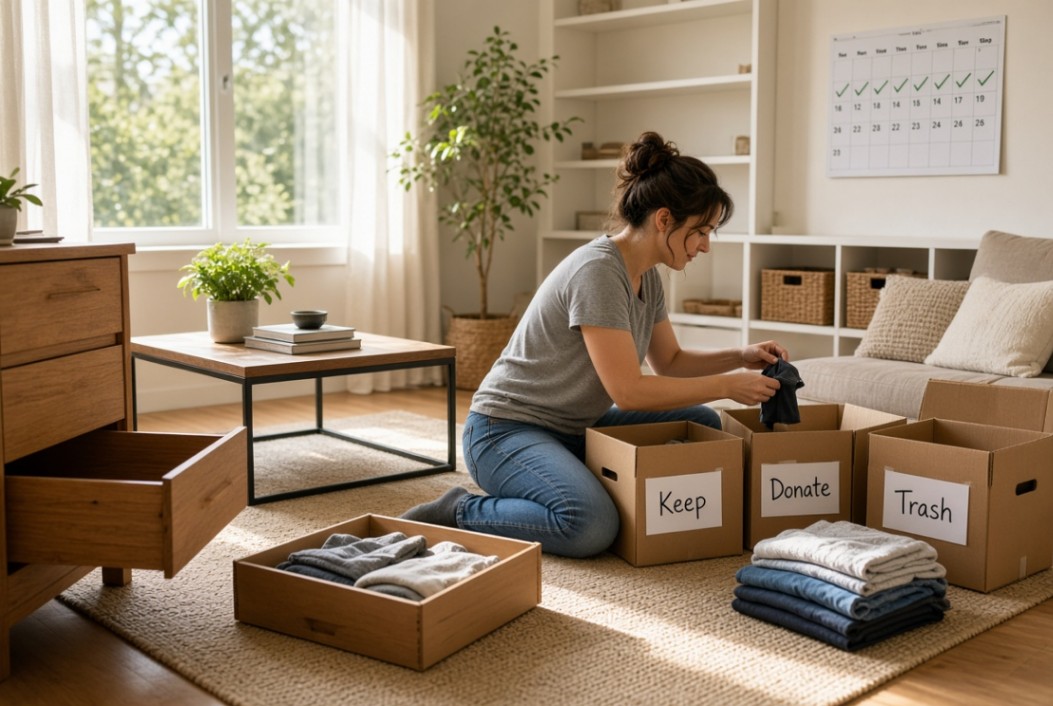
A 30-day declutter challenge can help you clear unused clothes, shoes, bags, jewellery, hair and accessories without emptying your entire wardrobe in one exhausting weekend. The practical method is simple: focus on one small category each day, decide what stays, and create a clear next step for every item you remove.
For many Nigerian homes, decluttering is not only about having fewer belongings. It can also create space, make everyday dressing easier, support donations and keep wearable items in circulation. Nigeria’s secondhand fashion economy includes street markets, online sellers, tailors, resellers and buyers looking for affordable clothing; reported prices can range from about ₦500 for simple pieces to ₦20,000 or more for better-quality items, depending on the item and condition.
This challenge works for a student in Lagos, a busy parent, a shared apartment or a family home. You can complete it in 15–30 minutes per day, using only four sorting groups:
The 30-day declutter challenge is divided into five stages:
| Stage | Days | Main focus |
|---|---|---|
| Prepare | 1–3 | Set rules, gather supplies and inspect your space |
| Clothing | 4–12 | Sort everyday wear, occasion pieces and basics |
| Shoes and accessories | 13–18 | Reduce duplicates and identify repairable items |
| Selling and giving | 19–24 | Photograph, price, donate or arrange handovers |
| Reset and maintenance | 25–30 | Finish decisions and create a routine |
A useful rule is to handle each item only once during a session. Avoid creating a “maybe” pile that remains untouched for weeks. If an item is uncertain, place it in a dated review bag and revisit it after 30 days.
You do not need expensive storage products. Useful supplies include:
How Far Can ₦5,000 Really Go at a Thrift Market?
10 Thrift Finds Under ₦2,000 You Need to See
How to Recreate a Celebrity Look With Thrift Pieces
Thrift Date Night Outfits That Don’t Look Cheap
Thrift Outfit Ideas for Campus: Stylish School Looks on a Budget
Thrifted Street Style: Outfits Spotted on Lagos Streets
Have something to give away or sell?
Post your first listing — it only takes a couple of minutes. Or browse listings near you.
Before starting, choose a place for each category. For example, one bag can hold donations, one can hold items for sale, and one can hold damaged pieces for repair or textile reuse.
Start with one wardrobe, drawer, shoe rack or storage box rather than the whole home. Take a quick “before” photo so you can see the change later.
Record the number of items in the zone if that motivates you. The number is not a target; it is simply a way to measure progress.
Write down rules that match your lifestyle. Examples include:
These rules make decisions more consistent and reduce the temptation to keep everything because it was expensive or received as a gift.
Remove everything from one drawer, shelf or wardrobe rail. Clean the empty space, then return only items that belong there.
Do not use this day to buy organisers. First reduce the volume; then assess what storage is actually needed.
Clothing usually takes the longest because it carries memories, identity and future plans. Work by type rather than pulling out every garment at once.
Check for:
A faded cotton T-shirt may still work as homewear, but it does not need to occupy the same space as clothing for school, work or outings.
Group items by sleeve length, colour or use. For workwear, check collars, cuffs and buttons. A missing button is different from fabric that has become too weak to repair.
Try on pieces that have not been worn recently. Check the waist, zip, pockets, hems and inner-thigh wear.
If the cut is useful but the fit is poor, place it in the alteration group rather than keeping it indefinitely. A tailor may be able to adjust some garments, while others may not be practical to alter.
Separate:
A garment kept for a future event needs a realistic reason and a clear storage location. “Maybe one day” is not the same as a confirmed use.
Nigerian wardrobes often include aso-ebi, Ankara, lace, kaftans, wrappers, agbadas and traditional outfits. Consider the cost of storage and the likelihood of future use without dismissing cultural or sentimental value.
For items with emotional importance, create a small memory section. This prevents every sentimental item from taking over the active wardrobe.
Check elastic, fabric condition and hygiene. Items that are no longer suitable for personal wear generally should not be passed to another person as clothing.
Some clean cotton pieces may be repurposed as cleaning cloths, depending on their condition and household use.
Check whether each item fits your current activities. A gym top, swimming item or travel jacket that has not been used for years may belong in the give-away or resale group.
Keep protective or specialised clothing only when it remains functional and relevant.
Children outgrow clothing quickly. Sort by:
Label bags clearly if passing clothing between siblings or relatives. This makes future use easier and prevents usable garments from being forgotten.
Place all clothing outside the wardrobe and review the four groups. Wash and dry items intended for donation or sale. Do not hide unresolved items back in the wardrobe.
Inspect soles, heels, stitching, odour, peeling material and broken fasteners. Pair each shoe and remove single shoes unless there is a clear repair plan.
A worn sole may be repairable, while synthetic leather that is peeling extensively may not have a useful second life as footwear.
Review heels, sandals, trainers, boots and traditional footwear separately. Keep the pairs that serve identifiable occasions, but avoid storing multiple pairs that perform the same function.
Photograph branded or high-quality shoes in natural light if they enter the resale group.
Empty every pocket, then check:
A clean bag with minor hardware damage may be suitable for repair or resale. A heavily damaged lining may need a lower price description or a different reuse option.
Sort jewellery by material, condition and frequency of use. Keep matching pairs together and separate pieces that need cleaning or repair.
Avoid making claims about precious-metal content unless there is reliable documentation. For a secondhand listing, describe visible features accurately instead.
Sort wigs, extensions, bonnets, scarves, clips, combs and hair tools. Items that are personal-use products require extra care when considering whether they are appropriate for passing on.
Do not share products that are visibly contaminated, damaged or unsuitable for hygienic reuse. Follow the manufacturer’s care instructions for cleaning where applicable.
Gather belts, caps, scarves, gloves, sunglasses and costume accessories. Small items often create clutter because they are stored in several places.
Use one labelled box or drawer for accessories that remain. Repeated duplicates can move to donation, swapping or resale.
| Question | Keep | Give away or donate | Sell or swap | Repair or reuse |
|---|---|---|---|---|
| Is it usable now? | Yes | Yes | Yes | Not yet |
| Is the condition clear? | Good | Clean and wearable | Describe accurately | Damage is identifiable |
| Is there a realistic user? | You | Someone else | A buyer or swap partner | You or a craft/reuse project |
| Next action | Store properly | Wash, pack and arrange | Photograph and list | Set a repair date |
| Example | Regularly worn jeans | Outgrown children’s clothes | Branded handbag | Shirt missing a button |
Wash wearable clothing where possible, dry it completely and pack items by type or size. A note such as “women’s tops, mixed sizes” helps the recipient understand the contents.
Donation does not remove the need for honest condition checks. Items that are dirty, mouldy or unsafe to wear may create extra work for the recipient.
Select items with a clear use case and reasonable condition. Gather details such as:
A listing that says “black dress, size 12, worn twice, small loose thread near the hem” gives a buyer more useful information than “fine dress, urgent sale.”
Use daylight and a clean background. Take:
Do not use heavily edited images that change the colour of the item. Accurate photos reduce misunderstandings during direct buyer-seller conversations.
Secondhand pricing varies by brand, condition, demand, size and location. Reported Nigerian thrift prices range widely, from hundreds of naira for basic pieces to tens of thousands for selected items.
The table below is a planning guide, not a fixed market price:
| Item condition | Example asking range |
|---|---|
| Basic, clean everyday top | ₦1,000–₦4,000 |
| Good-condition trousers or jeans | ₦2,000–₦8,000 |
| Occasion dress or gown | ₦4,000–₦20,000+ |
| Clean handbag | ₦3,000–₦15,000+ |
| Trainers or sandals in good condition | ₦3,000–₦15,000+ |
| Costume jewellery bundle | ₦1,000–₦5,000 |
These figures are illustrative. Check comparable local listings and adjust for visible wear, brand, fabric, season and the cost of repairs.
For peer-to-peer transactions:
Nigeria’s Federal Competition and Consumer Protection framework recognises consumer protection responsibilities, but a private secondhand transaction can still involve practical risks. A marketplace’s safety guidance should therefore complement, not replace, careful judgement and accurate descriptions.
Set a personal deadline for each item:
If an item remains unsold after a reasonable period, revise the description, adjust the price, offer a bundle or move it to another category.
Open the dated review bag. Ask whether the item was missed during the review period. If not, give it a defined next step rather than returning it automatically.
Group clothes by use, not only by colour. For example:
Leave enough space to see what you own. An overfilled wardrobe makes repeated buying and forgotten clothing more likely.
When adding a similar item, record what it replaces. This is not a rule that applies to every purchase, but it can make wardrobe growth visible.
For students, a simple note might read: “Bought one black trouser; review two older pairs before the next clothing purchase.”
Write down repair needs with an estimated action:
| Item | Issue | Action |
|---|---|---|
| Trousers | Loose hem | Ask a tailor for alteration |
| Handbag | Broken zip | Check repair cost |
| Sandals | Loose strap | Repair if structure remains sound |
| Shirt | Missing button | Replace button |
| Dress | Small seam opening | Stitch before storage |
Avoid keeping a repair pile without dates. If an item has no realistic repair plan, move it to reuse, donation or resale with honest disclosure.
Wipe shelves, air shoes and fold clothing neatly. Store delicate pieces away from moisture and direct sunlight where practical.
For Lagos and other humid environments, periodic airing can help reduce musty storage conditions. Do not store damp clothing.
Measure progress using practical information:
The goal is not a perfect minimalist home. The useful result is a clearer system in which every remaining item has a place and every removed item has a responsible next step.
Sentimental pieces take longer to evaluate. Begin with duplicates, damaged basics or clothing that no longer fits your current routine.
This article is for educational purposes only and does not constitute professional advice. Always follow safe trading practices and use your own judgement.